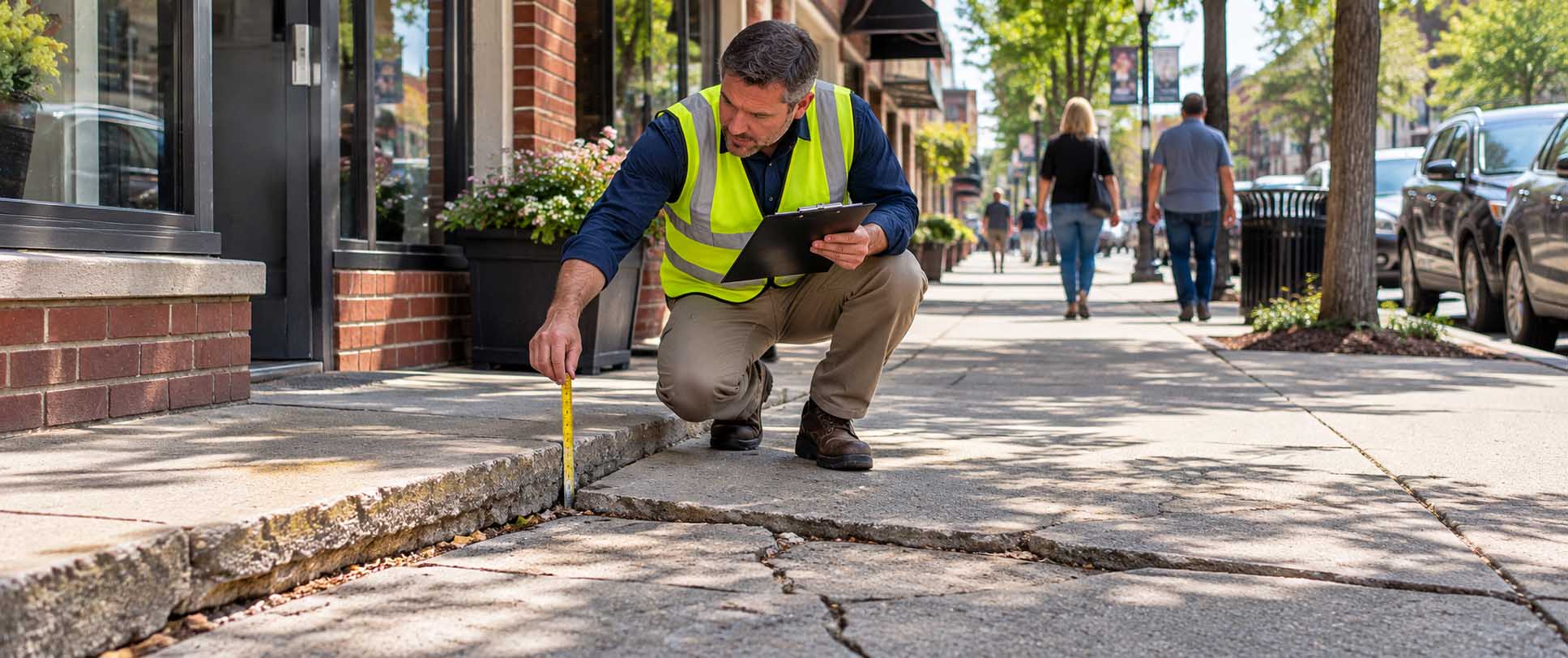
Sidewalk accident liability concerns who may be legally responsible when a pedestrian suffers an injury because of an unsafe sidewalk condition. Depending on the location and circumstances, responsibility may involve a property owner, municipality, contractor, or another party responsible for the walkway.
However, determining liability is not always straightforward. A cracked sidewalk, raised pavement slab, or icy walking surface does not automatically establish negligence.
The legal analysis generally considers who had responsibility for the sidewalk, whether a dangerous condition existed, and whether that condition caused the injury.
Understanding these factors is especially useful in New York, where sidewalk maintenance obligations can differ between municipalities and property types.
Common Causes of Sidewalk Accidents
Sidewalk accidents can result from structural defects, weather conditions, or maintenance problems.
Common hazards include:
- Raised or uneven concrete slabs
- Cracked or broken pavement
- Loose paving materials
- Open holes or damaged utility covers
- Ice and snow accumulation
- Tree roots lifting sidewalk sections
- Construction debris
- Poor drainage creating slippery surfaces
For example, a pedestrian may trip when one concrete slab sits noticeably higher than the adjoining section.
However, the presence of a defect alone does not determine whether someone is legally responsible. The condition, location, and applicable legal duties must also be considered.
Who May Be Responsible for a Sidewalk Accident?
Potential responsibility depends on property ownership, maintenance obligations, and applicable laws.
Adjacent Property Owners
In some New York municipalities, owners of property adjoining a sidewalk have legal responsibilities concerning sidewalk maintenance.
For example, New York City generally places certain sidewalk maintenance duties on adjoining property owners, subject to statutory exceptions.
However, those rules do not automatically apply throughout Nassau County or Suffolk County. Therefore, the municipality and property classification matter.
Municipal Governments
A city, town, village, or other public entity may have responsibilities concerning certain sidewalks.
However, municipal liability can involve special legal requirements. Some municipalities have prior written notice laws that affect claims involving sidewalk defects.
In addition, shorter filing deadlines and notice-of-claim requirements may apply.
Contractors and Other Parties
Construction companies, maintenance contractors, and utility providers may sometimes contribute to hazardous sidewalk conditions.
For example, a contractor who leaves an excavation area improperly secured may create a pedestrian hazard.
However, responsibility depends on the contractor’s conduct, contractual obligations, and applicable law.
How Is Sidewalk Accident Liability Determined?
Determining responsibility for a sidewalk injury generally requires examining several connected questions.
First, who had a legal duty concerning the location?
Second, what specific condition allegedly caused the accident?
Third, did the responsible party create the condition or have legally sufficient notice of it?
Finally, did the condition cause the pedestrian’s injury?
For example, a raised sidewalk slab may have existed for a substantial period before an accident.
Evidence about its condition, visibility, and maintenance history may help establish whether the responsible party should have addressed it.
However, the legal outcome depends on the full circumstances.
Sidewalk Accident Liability on Long Island
Sidewalk maintenance responsibilities on Long Island can vary according to the municipality and location.
For example, the legal framework applicable to a sidewalk in a Nassau County village may differ from the rules governing a walkway in a Suffolk County town.
In addition, claims involving public property may raise different procedural requirements from claims against private property owners.
Individuals seeking injury claim guidance can review information about personal injury legal services provided by Siben & Siben, LLP, a law firm based in Bay Shore, New York.
Because local regulations and filing requirements can affect sidewalk cases, identifying the correct potentially responsible party is an important early consideration.
Evidence Needed to Establish Sidewalk Accident Liability
Evidence can help establish the condition of the sidewalk and the circumstances surrounding an injury.
Useful documentation may include:
- Photographs of the exact defect
- Measurements showing pavement irregularities
- Images of the surrounding sidewalk
- Witness statements
- Nearby surveillance footage
- Maintenance or repair records
- Relevant municipal records
- Medical documentation
For example, a photograph showing the height difference between adjoining sidewalk slabs may help explain how a pedestrian tripped.
However, photographs do not necessarily establish how long the defect existed.
As a result, investigators may need additional evidence to evaluate notice and legal responsibility.
What Should Someone Do After a Sidewalk Injury?
Medical attention should be the first priority after an injury.
Once immediate safety concerns are addressed, practical documentation may help preserve important information.
Record the Exact Accident Location
Identify the street address, nearby property, and specific section of sidewalk involved.
This information may help determine which entity had responsibility for the location.
Photograph the Sidewalk Hazard
If it is safe, take photographs showing the defect from different angles.
Include surrounding landmarks that help identify the location.
Preserve Relevant Information
Keep medical records, accident-related correspondence, and witness contact details.
In addition, note the date, approximate time, and environmental conditions.
Comparative Negligence in Sidewalk Injury Claims
New York generally follows comparative negligence principles.
As a result, a pedestrian’s own conduct may affect the allocation of responsibility.
For example, questions may arise about visibility, distractions, or whether the pedestrian could reasonably have avoided a hazard.
However, the existence of an observable defect does not automatically establish negligence by the injured person.
The evaluation depends on the circumstances and the conduct of the potentially responsible parties.
Are Sidewalk Defects Always Legally Dangerous?
No. Not every pavement irregularity creates legal liability.
Courts may consider factors such as the defect’s dimensions, appearance, location, and surrounding conditions.
For example, a small pavement irregularity may present different circumstances from a substantial elevation difference near a heavily used entrance.
However, there is no universally applicable measurement that automatically determines liability in every sidewalk case.
Instead, the surrounding circumstances remain important.
Filing Deadlines and Sidewalk Accident Liability Claims
Sidewalk injury claims may involve different deadlines depending on the responsible party.
Claims against public entities can require prompt action because special notice procedures and shorter time limits may apply.
For example, New York General Municipal Law § 50-e establishes notice-of-claim requirements for certain claims against public entities. Its application depends on the particular claim and governing law.
Private-party claims may follow different rules.
Therefore, identifying whether a municipality or private entity may be responsible can affect the steps needed to preserve a potential claim.
Missing an applicable deadline may limit available legal options.
Final Thoughts
Sidewalk accident liability involves more than identifying cracked pavement or an uneven walking surface.
The location of the sidewalk, applicable maintenance duties, notice of the hazard, and evidence connecting the condition to the injury all influence the legal analysis.
Because New York municipalities may follow different rules, determining the potentially responsible party is particularly important.
Understanding these considerations can help injured pedestrians preserve relevant evidence and make informed decisions about possible legal claims.