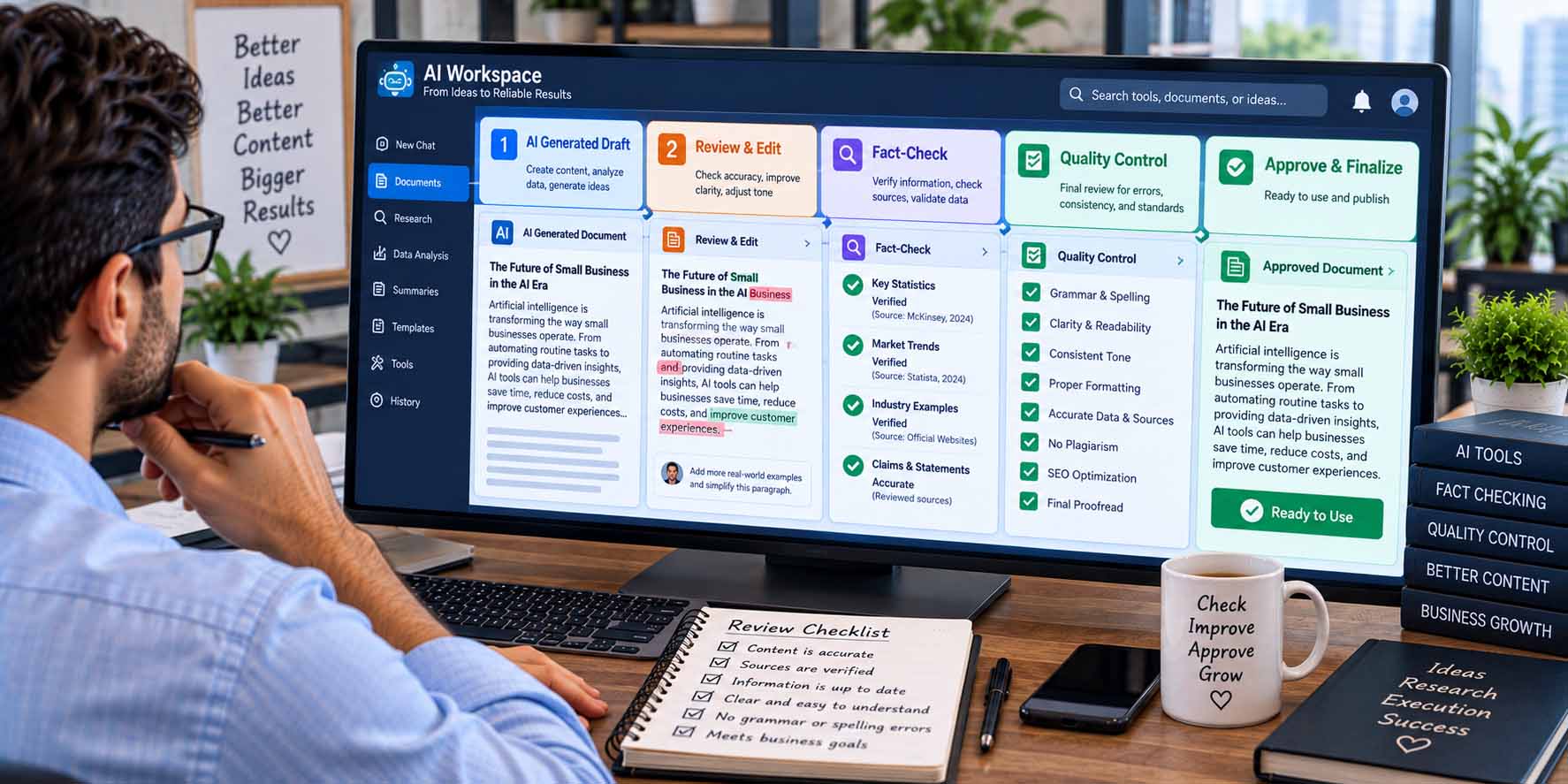
Human review of AI is important because AI-generated output can be useful without always being accurate, complete, appropriately contextualized, or suitable for immediate business use. Employees can verify facts, identify missing context, correct mistakes, protect brand standards, and decide whether an AI-generated result is appropriate for its intended purpose.
For small businesses, human oversight does not eliminate the benefits of AI. Instead, it provides a quality-control layer between automated assistance and consequential business actions.
AI Output Is Not Automatically a Finished Product
Generative AI can produce drafts, summaries, ideas, classifications, explanations, and other outputs quickly.
However, speed and presentation quality should not be confused with reliability.
An AI-generated answer may sound confident and polished while containing an incorrect detail or assumption. It can also misunderstand an instruction, overlook important context, or provide information that does not fit the specific business situation.
Therefore, businesses should treat many AI outputs as material to evaluate rather than automatically as finished work.
Human Review of AI Helps Verify Accuracy
Accuracy is one of the clearest reasons for maintaining human oversight.
Consider an employee using AI to summarize a business document. The summary may appear reasonable, but an important condition, exception, deadline, or qualification could be omitted.
A reviewer who understands the original material can compare the summary against its source.
The same principle applies to AI-assisted research, customer communications, internal reports, product information, and other business content.
The more important the information is, the more important appropriate verification becomes.
People Provide Business Context
AI systems work with the information and instructions available to them. They do not automatically possess the full context surrounding a particular company, customer, project, or decision.
An employee may know that a long-term customer requires special handling, that a project has an unusual constraint, or that a seemingly reasonable recommendation conflicts with an internal policy.
That context can materially change whether an AI-generated response is useful.
Human reviewers can bring operational knowledge, customer understanding, business priorities, and situational judgment into the final decision.
Quality Control Protects Business Communication
AI is frequently used to assist with writing.
It may draft emails, marketing materials, customer-service responses, internal documentation, FAQs, or product descriptions.
Human review can check whether that content matches the intended tone, communicates clearly, and accurately represents the business.
For companies exploring AI, technology, finance, and broader operational practices, GrowBizLab provides read this post here as an additional source of small-business information.
Even grammatically correct content may be inappropriate if it is too generic, overly formal, inconsistent with the brand, or missing information the recipient needs.
A person familiar with the audience can make those distinctions.
AI Can Miss Important Nuance
Many business situations are not purely factual.
Customer complaints, employee communication, negotiations, sensitive messages, and unusual service problems can require judgment about tone and context.
An AI system may help prepare a draft, but the person reviewing it can consider questions such as:
- Is this response appropriate for the situation?
- Does it address the customer’s actual concern?
- Could the wording be misunderstood?
- Is important context missing?
- Does the response make a commitment the company cannot fulfill?
- Should this issue be handled by a different person?
These questions go beyond simply checking spelling or grammar.
The Level of Review Should Match the Risk
Not every AI-assisted task requires the same degree of oversight.
Brainstorming possible meeting titles is very different from preparing information that could affect a contract, financial decision, employee matter, or customer commitment.
Businesses can adjust their review process according to the consequences of an error.
Low-risk internal drafts may require a quick check. Higher-impact outputs may need verification against original documents, reliable external sources, company policies, or qualified professional guidance.
This approach makes human oversight proportionate rather than unnecessarily burdensome.
Human Review Helps Identify Unsupported Claims
AI-generated content may occasionally include claims that require evidence.
This is particularly relevant when AI assists with research, educational material, marketing content, reports, or comparisons.
A reviewer should check whether factual statements are supported by appropriate sources rather than assuming that a detailed answer is correct because it sounds authoritative.
If the business cannot verify an important claim, it may need to remove, qualify, or research it further.
This helps prevent uncertain information from moving through the organization as established fact.
Oversight Is Also Important for Customer-Facing AI
AI can assist customer-service teams by categorizing requests, summarizing conversations, suggesting replies, or answering routine questions.
However, businesses should define when employees need to become involved.
A straightforward informational request may require relatively little intervention. A billing dispute, unusual complaint, sensitive account issue, or request outside normal policy may require direct human handling.
Clear escalation rules can help businesses combine automation with appropriate customer support.
Human Review Can Improve the AI Workflow
Oversight is not only about finding mistakes.
It can also reveal whether the AI workflow itself is well designed.
If employees repeatedly make the same corrections, the business can investigate why.
Perhaps the instructions need to be clearer. The AI may lack necessary context, the task may be poorly suited to automation, or the workflow may need a better source document.
Tracking recurring corrections can therefore help improve prompts, processes, templates, and decisions about where AI should be used.
Accountability Should Remain Clear
When a business uses AI, responsibility for important work should not become ambiguous.
Employees and managers should understand who reviews an output, who approves it, and who is responsible for the final action.
This is especially useful when AI becomes part of repeatable workflows.
A process might specify that AI prepares a draft, an employee verifies the information, and an authorized person approves certain higher-impact communications or decisions.
Clear ownership makes AI assistance easier to manage as usage expands.
AI Works Best With Appropriate Oversight
AI can reduce time spent on drafting, summarizing, organizing information, and other routine knowledge tasks. Those advantages do not require businesses to accept every generated result without checking it.
Human review of AI provides the context, verification, judgment, and accountability that automated output may lack.
By matching the level of review to the importance of the task, checking critical information against reliable sources, and keeping responsibility clearly assigned, small businesses can benefit from AI assistance while maintaining stronger control over the quality of their work.